Customer Service & Retention AI
Re:amaze
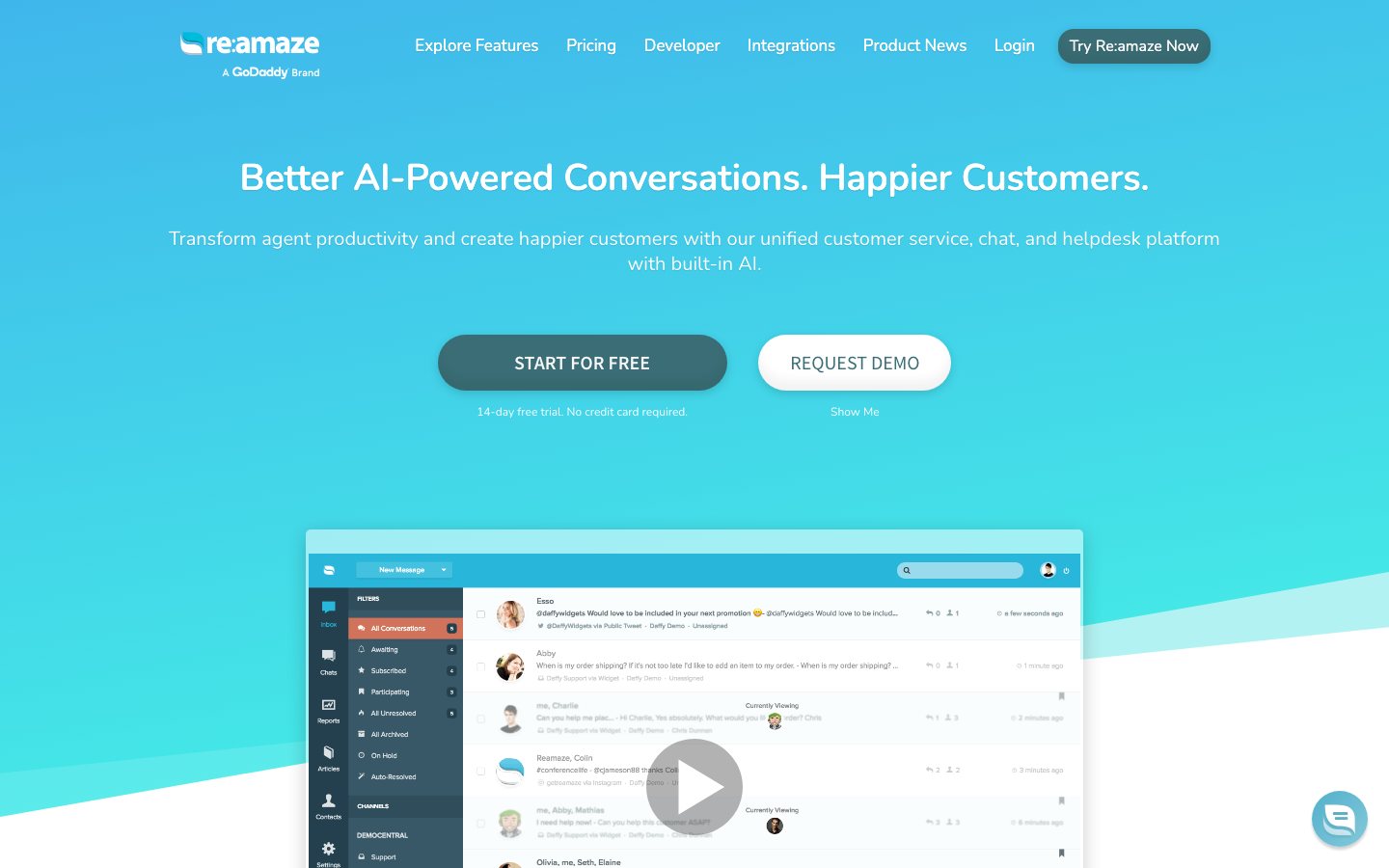
Re:amaze is an ecommerce customer-service suite combining shared inboxes, live chat, social channels, FAQs, proactive messages, classic bots, and a newer AI Agent. The AI Agent answers from help-center content, response templates, and connected store data, then counts a resolution only when the thread stays entirely with AI. Plans start at $29 per user, with included resolutions and $0.85 overage.
Before you start
- Choose one bounded, reversible customer-service or retention workflow to test.
- Prepare current policies, representative conversations, order context, and escalation rules, removing sensitive fields the trial does not need.
- Record the current resolution quality, reopen rate, response time, and customer satisfaction, then name the approver and stop conditions.
Operator-ready setup plan
Start with one real task
Do not begin with a store-wide rollout. Pick one reversible task where Re:amaze can help you handle customer questions, retention signals, and follow-up work.
Checkpoint: The input boundary, owner, and one primary measure from resolution quality, reopen rate, response time, and customer satisfaction are written down.
Prepare the input and guardrails
Collect only the current policies, representative conversations, order context, and escalation rules needed for this test. Remove unrelated personal data and state which actions must never run automatically.
Checkpoint: Every input has a known source, sensitive fields are minimized, and the approver knows what the trial can read or change.
Configure a contained trial
Follow the official setup path, connect the fewest accounts possible, and grant only the permissions this test needs. Let Re:amaze recommend before it acts.
Checkpoint: You have a customer-service or retention workflow that a responsible operator can inspect, and it stayed inside the approved boundary.
Review it against a baseline
Do not judge the result by fluency. Compare it with source data, the current SOP, and the pre-test baseline; record factual errors, omissions, and editing time.
Checkpoint: resolution quality, reopen rate, response time, and customer satisfaction has a pre-test baseline, and errors and exceptions are logged separately.
Expand in small batches with a stop rule
Increase one batch at a time and decide in advance what will stop the rollout. Add it to the regular SOP only after it repeatedly clears the quality bar.
Checkpoint: Wider use does not push error, complaint, or rework costs above the previous baseline.
How to test it
- Test one normal case, one edge case, and one case with a deliberately missing critical field.
- Compare the result with the pre-test baseline for resolution quality, reopen rate, response time, and customer satisfaction; do not record time saved alone.
- Review errors, human edits, permissions used, and unresolved exceptions before expanding scope.
Limits to account for
- We checked the public source and resource identity on 2026-07-19. That review does not cover every workflow result, and vendor performance claims are not treated as EcomAgentTools tests.
- A plausible answer can still conflict with store policy or expose customer data.
- This page reflects the review completed on 2026-07-19, not a permanent guarantee. Recheck the current documentation, pricing, and contract terms before production use.
Frequently asked questions
How do I add Re:amaze to the current SOP?
Map the input source, owner, approval point, and exception path, then replace one existing step. Do not rewrite the whole operation just to accommodate a new tool.
Which metrics show whether it is worth keeping?
Track resolution quality, reopen rate, response time, and customer satisfaction. Pair quality and efficiency measures so output volume is not mistaken for a business result.
When is it not worth using?
It is usually a weak fit when volume is low, inputs stay incomplete, most cases need senior judgment, or review costs approach the cost of the old process.
Key features
Re:amaze is an ecommerce customer-service suite combining shared inboxes, live chat, social channels, FAQs, proactive messages, classic bots, and a newer AI Agent. The AI Agent answers from help-center content, response templates, and connected store data, then counts a resolution only when the thread stays entirely with AI. Plans start at $29 per user, with included resolutions and $0.85 overage.
- Shared inbox combines unlimited email inboxes, chat, and supported social channels
- Public and internal FAQs power self-service, classic bots, and AI knowledge
- AI Agent answers from help-center content, templates, and connected store data
- Order Bot, Welcome Bot, custom bots, proactive Cues, intents, and workflows cover deterministic cases
- Higher plans add multi-brand, visitor view, SMS, voice, advanced reporting, roles, CSAT, and video
- AI testing, response sources, corrections, and learned answers support ongoing quality review
Best for
You are handling recurring pre-sale or post-sale questions. The first decision to test is whether Shared inbox combines unlimited email inboxes, chat, and supported social channels and Public and internal FAQs power self-service, classic bots, and AI knowledge hold up together… Consider it when these outcomes matter: Shared inbox combines unlimited email inboxes, chat, and supported social channels, helping you reduce manual routing and repeated replies; Put Public and internal FAQs power self-service, classic bots, and AI knowledge into the current flow to keep useful order or customer context available during handling; Use AI Agent answers from help-center content, templates, and connected store data in this step to start by validating a high-frequency, well-bounded intent. Confirm before rollout: Total cost combines seats or conversation volume with AI-resolution usage.
Pricing analysis
Current published or described options are Starter: $59/month flat rate; Basic: $29/user/month; Pro: $49/user/month; Plus: $69/user/month; Additional AI resolutions: $0.85/resolution. Basic is the first plan worth testing for overall value: it moves beyond the entry tier's main limits without taking on the top tier's budget. The highest tier becomes better value only when its advanced capabilities and lower unit cost stay in regular use. Complete cost also includes agent seats, billable conversations or resolutions, channel add-ons, seasonal overages, onboarding, and quality-review time; model both normal and peak periods. A custom quote should state the billing unit, minimum commitment, overages, add-ons, implementation scope, renewal terms, and data-export path.
Pros
- Combines deterministic bots, a modern AI agent, human support, and knowledge in one mature suite
- AI resolutions are not billed when the conversation escalates to a human
- Seat-based and volume-based plan structures support different team shapes
- Public pricing exposes included AI resolutions and the $0.85 overage clearly
Limitations
- Total cost combines seats or conversation volume with AI-resolution usage
- Included AI resolutions scale with seats and may be small for automation-heavy teams
- Multiple bot types and pricing structures require careful configuration and forecasting
- Uninstalling the Shopify app does not automatically cancel the separate Re:amaze subscription
Selection guidance
Document the current manual process, data sources, owner, and recovery path, then run one channel and two high-volume, low-risk intents with real business data. Cover permission boundaries, null and exception data, duplicate execution, human override, third-party sync delays, export, and rollback. Also run these product checks: Test one normal case, one edge case, and one case with a deliberately missing critical field.; Compare the result with the pre-test baseline for resolution quality, reopen rate, response time, and customer satisfaction; do not record time saved alone.. Keep the pilot live for a complete business cycle and compare correct-resolution rate, handoff accuracy, reopen rate, CSAT, and total cost per resolved conversation with the pre-pilot baseline. Contract only if quality, controllable risk, and total cost all pass, and explicitly test these known constraints: Total cost combines seats or conversation volume with AI-resolution usage; Included AI resolutions scale with seats and may be small for automation-heavy teams.
Published pricing
- Starter
- $59/month flat rate
- Basic
- $29/user/month
- Pro
- $49/user/month
- Plus
- $69/user/month
- Additional AI resolutions
- $0.85/resolution
Alternatives
Content checked: