Supply Chain & Fulfillment AI
Finale Inventory
Finale Inventory is a cloud inventory and order platform for multichannel ecommerce and warehouse teams that need synchronized stock, barcode operations, and control over higher-volume fulfillment. It is designed for multichannel operations at scale, with a published capacity range far beyond that of a basic Shopify inventory app.
- Platforms
- Amazon · Shopify · Custom API
 Official videoWhat is Descartes Finale?Click to play · Descartes Finale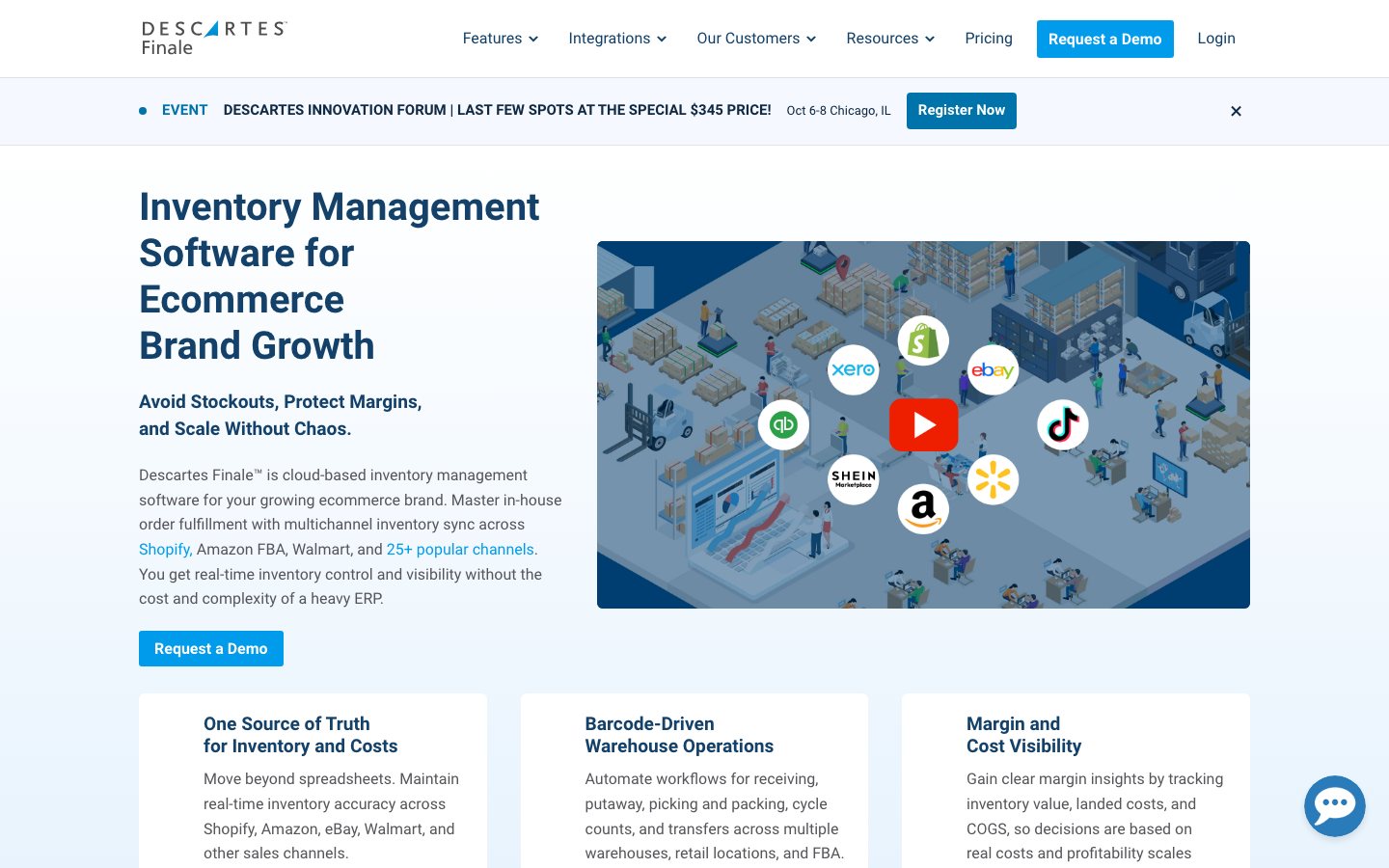
Buying view: It is designed for multichannel operations at scale, with a published capacity range far beyond that of a basic Shopify inventory app. Channel mappings, order-state rules, and warehouse exceptions must be reconciled in a test account before inventory synchronization is used to drive fulfillment.
Capabilities
Finale Inventory gives multichannel sellers one place to synchronize stock, receive channel orders, manage warehouse and barcode work, and plan purchasing or FBA replenishment. Its biggest advantage is practical control for high-volume inventory operations: channel sync, multi-location quantities, fulfilment, and reorder work share the same item and stock records.
What problem it addresses
High-volume multichannel operations need a single inventory and fulfillment record across connected channels and warehouses, including FBA replenishment.
How people use it
Multi-channel inventory management. Ecommerce and fulfillment workflow support. FBA replenishment and inbound-shipment-related capabilities.
Orders arrive from connected channels, Finale allocates current stock, warehouse staff pick and ship, and updated quantities return to the channels.
The team reviews reorder needs, creates purchasing or destination replenishment work, receives or transfers stock, and refreshes availability.
What each module does and its role
Multichannel inventory control
Finale keeps stock records aligned across supported sales channels and inventory locations. Operations teams use the shared quantity view before allocating or publishing available stock.
Order and fulfillment management
Order workflows bring supported ecommerce orders into the inventory operation for picking, shipping and status updates. The handoff connects a sale to stock movement while keeping exceptions visible to an operator.
Barcode and warehouse operations
Barcode and warehouse tools support receiving, picking, counting and other controlled location work. They turn the system record into a repeatable physical workflow that a warehouse team can verify.
Purchasing and replenishment
Purchasing tools use inventory position and reorder inputs to prepare replenishment work. Buyers review supplier, quantity and timing before committing the resulting order.
Commercial plans
This table reflects the current public pricing surface checked on 2026-09-03. Each row keeps the plan's documented allowances, capabilities and separately priced add-ons together so the tiers can be compared without treating the headline price as the whole offer.
Finale Inventory public plans
| Product or sales surface | Scope | Public price and status |
|---|---|---|
| Essentials | For businesses with one or two warehouses that are replacing spreadsheets and bringing early operational complexity under control. Included plan entitlements
| Starts at $499/month |
| Growth | For growing multichannel teams that need a mobile warehouse module and human-assisted support. Included plan entitlements
| Starts at $799/month |
| Enterprise | For high-volume operations that need APIs, EDI and contracted service levels. Included plan entitlements
| Custom quote |
Comparable tools: price and workflow
| Tool | Workflow difference | Official public price reference |
|---|---|---|
| Cin7 | Inventory, orders, purchasing, and multiple selling channels need to share one operating system. Migration, SKU and location definitions, integrations, permissions, and exception handling matter more than a feature checklist. | $349/month |
| Extensiv Order Manager | Multi-channel order flow, inventory availability, routing, and fulfillment exceptions have outgrown manual coordination. Use a test account to validate channel mapping, order states, write permissions, oversell handling, and migration effort. | Custom quote |
| Fishbowl | The brand makes or assembles products and needs inventory decisions to connect with BOMs, work orders, or warehouse execution. Confirm manufacturing modules, data model, deployment, and channel synchronization rather than assuming an inventory plan covers production. | From $229/month |
| Katana | The brand makes or assembles products and needs inventory decisions to connect with BOMs, work orders, or warehouse execution. Confirm manufacturing modules, data model, deployment, and channel synchronization rather than assuming an inventory plan covers production. | $0 |
| ShipBob | The priority is outsourced storage, pick-pack-ship operations and a fulfillment network, not only software control of internal stock. Build a model around item dimensions, inbound flow, destinations, returns, service levels, and peak season; the commercial decision is not a SaaS-plan comparison. | Contact sales |
Frequently asked questions
How does Finale Inventory fit into an ecommerce workflow?
Operators synchronize channel and warehouse stock, route fulfillment work, and use shared inventory records to plan replenishment for FBA and other destinations.
How is Finale Inventory priced?
The public price reference shown here is: Essentials — from $499/month.
What is the main Finale Inventory boundary to check?
Channel mappings, order-state rules, and warehouse exceptions must be reconciled in a test account before inventory synchronization is allowed to drive fulfillment.
Native connections
Use the Commercient connector listed by Finale to automate inventory and CRM data exchange; the connection is mediated by Commercient rather than built directly by Finale.
Finale Inventory integrationsSources
Content checked: