Dynamic Yield
Dynamic Yield helps growth and merchandising teams test and personalize product content, recommendations and offers across web, app and email. Operations can configure campaigns, while development work is usually needed to connect the store's product, event and identity data.
Dynamic Yield helps growth and merchandising teams test and personalize product content, recommendations and offers across web, app and email. Operations can configure campaigns, while development work is usually needed to connect the store's product, event and identity data.
Dynamic Yield helps growth and merchandising teams test and personalize product content, recommendations and offers across web, app and email.
- Views
- 0
- Uses
- 0
- Favorites
- 0
- Editorial Score
- 76/100
- Supported Platforms
- Shopify · Custom API
- Freshness
- Last reviewed Aug 2026 — Due for refresh
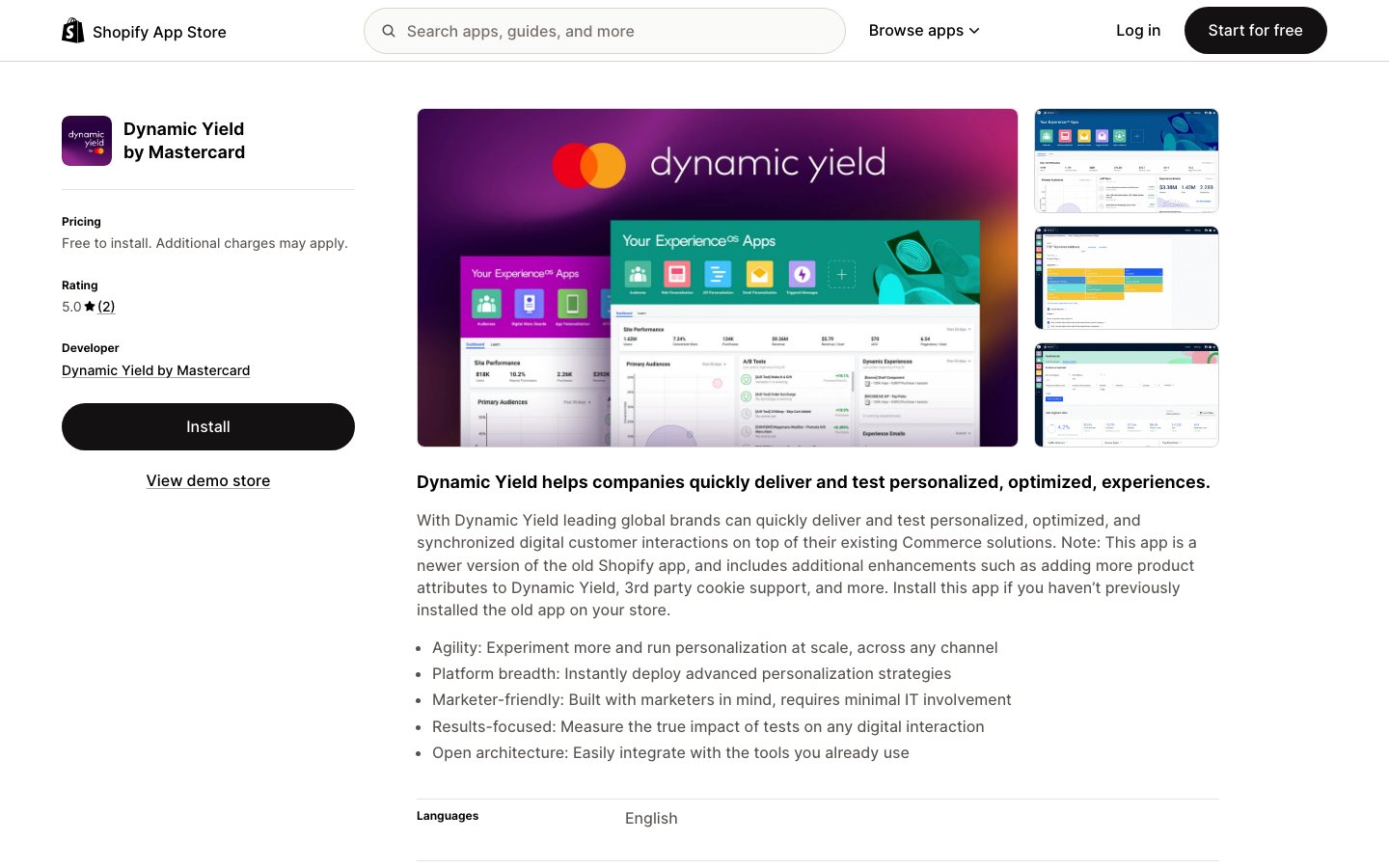
Buying view: Dynamic Yield helps growth and merchandising teams test and personalize product content, recommendations and offers across web, app and email. Operations can configure campaigns, while development work is usually needed to connect the store's product, event and identity data.
Capabilities
The platform can change a customer-facing placement such as a product-page recommendation area, an offer or a content block, then compare versions through experiments. Its value depends on accurate product feeds, visitor identification, inventory availability and conversion events—not only on the activity configuration screen.
What problem it addresses
Dynamic Yield helps growth and merchandising teams test and personalize product content, recommendations and offers across web, app and email. Operations can configure campaigns, while development work is usually needed to connect the store's product, event and identity data.
How people use it
The platform can change a customer-facing placement such as a product-page recommendation area, an offer or a content block, then compare versions through experiments. Its value depends on accurate product feeds, visitor identification, inventory availability and conversion events—not only on the activity configuration screen.
This composition map groups current Experience OS surfaces by where teams apply personalization and how they control or extend it. Web, email and app experiences are customer-facing surfaces; audience, sorting, algorithm and API tools support targeting, merchandising and experimentation around those surfaces.
What each module does and its role
Experience Web
Experience Web is the onsite surface for changing web content, products, messages and offers according to documented visitor signals. It carries personalization decisions to the storefront; the team still needs implementation ownership, measurement and control groups for the experiences it launches.
Experience Email and App
Experience Email and Experience App extend personalized content to email and native mobile-app experiences. They are additional customer surfaces rather than proof that one campaign automatically runs across every channel, so each connected channel and ownership boundary needs its own implementation check.
Sorting Optimizer
Sorting Optimizer is a merchandising tool for testing and targeting category-page ordering logic. It lets teams combine business rules and visitor affinity when arranging products, while the experiment design determines whether the observed result can be attributed to a sorting change.
Audience Hub
Audience Hub supplies the segmentation and audience-management work used by personalization programs. It helps teams define who should receive a treatment, but the audience definition does not by itself create or publish the web, email or app experience.
Algorithm Studio and API Campaigns
Algorithm Studio and API Campaigns extend the platform for custom recommendation logic and server-side delivery. They are implementation surfaces for teams that need more control than standard placements, and they require technical ownership rather than functioning as no-code merchandising controls.
Commercial plans
The Shopify listing says the app is free to install, but it still requires a paid Dynamic Yield account and external charges can be billed separately. Dynamic Yield uses a sales-led custom quote: share the intended traffic, channels, services, and implementation scope, then ask for a written line-item quote. A custom quote means sales prices your use case; it is not a free plan and it cannot be compared directly with a fixed public package price. Give each finalist the same assumptions before comparing costs. Some public G2 reviewers call pricing high, but those opinions are not a price list.
Dynamic Yield public commercial reference
| Product or sales surface | Scope | Public price and status |
|---|---|---|
| Shopify app installation | The Shopify app has no installation charge, but using it still requires a paid Dynamic Yield account. Sales gives a custom quote based on traffic, channels, services, and implementation scope. | No installation charge; a paid Dynamic Yield account is required |
| Dynamic Yield subscription | The Shopify app has no installation charge, but using it still requires a paid Dynamic Yield account. Sales gives a custom quote based on traffic, channels, services, and implementation scope. | Custom quote; ask sales for a written price based on traffic, channels, and selected services |
| Implementation and usage scope | The Shopify app has no installation charge, but using it still requires a paid Dynamic Yield account. Sales gives a custom quote based on traffic, channels, services, and implementation scope. | Custom quote; confirm included traffic, channels, services, integrations, and overage terms in writing |
Comparable tools: price and workflow
| Tool | Workflow difference | Official public price reference |
|---|---|---|
| Rebuy | A Shopify-focused team wants a more contained personalization and upsell program with a clearer self-serve starting path. Compare platform coverage, experimentation depth, rules, data architecture, and the total cost at actual order volume. | Platform One: $534/month at the current default calculator settingCart & Merchandising: Custom quoteCheckout & Post-Purchase: Custom quote |
| Nosto | Merchandising and onsite personalization are the priority, especially for a team wanting a commerce-specialist operating layer. Validate the needed module, channel scope, merchandising workflow, pricing model, and implementation responsibility rather than comparing AI labels. | Product Experience Cloud: Contact salesContent Experience Cloud: Contact sales |
| Bloomreach | The team also needs customer-data activation or lifecycle journeys alongside discovery and personalization. The suite can add broader data and campaign scope; assess whether the organization can operate those modules rather than buying a platform for one page test. | Custom: Contact sales |
| Algolia | Search and developer-controlled product discovery are the primary problem, not broad storefront experimentation. Algolia is generally a different implementation shape; compare search relevance, frontend ownership, data feeds, and the need for cross-surface testing. | Free: $0 (10K requests/month)Build: $1 per 1,000 requestsGrow: From $129/month |
| Constructor | The project centers on enterprise search, browse, recommendations, and catalog merchandising with a development-led implementation. Compare search and browse requirements, catalog-feed ownership, UI integration work, and whether broader journey experimentation is actually needed. | Constructor Connect installation: Free to installEnterprise product-discovery platform: Custom quote |
Frequently asked questions
Where should a team start with Dynamic Yield?
A single customer-facing placement with a clear business question is easier to evaluate than a site-wide change. For example, a team can compare a product-page recommendation area while keeping an unchanged experience available for part of the traffic.
What does the implementation need?
The documented setup uses product feeds, user or session identifiers, consent status and meaningful interaction or conversion events. Development ownership is needed for website scripts or APIs, performance checks and rollback planning.
Is the Shopify app a free Dynamic Yield plan?
The Shopify listing says the app can be installed for free, but it requires a paid Dynamic Yield account and may involve external charges. The platform itself uses a sales-led custom quote, so the proposal should state expected traffic, channels and implementation services.
Sources
- Dynamic Yield ecommerce overview
- Dynamic Yield recommendations
- Dynamic Yield optimization
- Experience APIs overview
- Experience APIs implementation guide
- Traffic allocation guide
- A/A-test guide
- Primary-metric guide
- A/B-result guide
- Dynamic Yield Shopify app listing
- G2 public customer reviews
- Security and compliance
- Dynamic Yield implementation overview
- Dynamic Yield Experience API basics
- Dynamic Yield API implementation best practices
- Dynamic Yield Capterra reviews
User reviews
2 reviewsChecked Aug 30, 2026
Shopify App Store listing: Dynamic Yield by Mastercard. These reviews cover this app listing, not every product surface from the vendor.
Show more
156 reviewsChecked Aug 28, 2026
Dynamic Yield product review collection
Comment content could not be retrieved. Use the link below to view comments on the original platform.
More reviews on G26 reviewsChecked Aug 28, 2026
Dynamic Yield eCommerce product review collection
Comment content could not be retrieved. Use the link below to view comments on the original platform.
More reviews on CapterraDynamic Yield by Mastercard
Content checked:
DY ist die Full Suite für Personalisierung. Wahnsinnig viele Möglichkeiten mit dem Tool die Experience der Kunden zu verändern!