Store Experience & Conversion AI
Algolia AI Shopping Assistant
Algolia helps ecommerce teams deliver product search, recommendations, and merchandising. Its alternatives section covers other search and discovery tools for a store's shortlist.
 Official videoBuild AI Shopping Agents in Minutes with Agent StudioClick to play · Algolia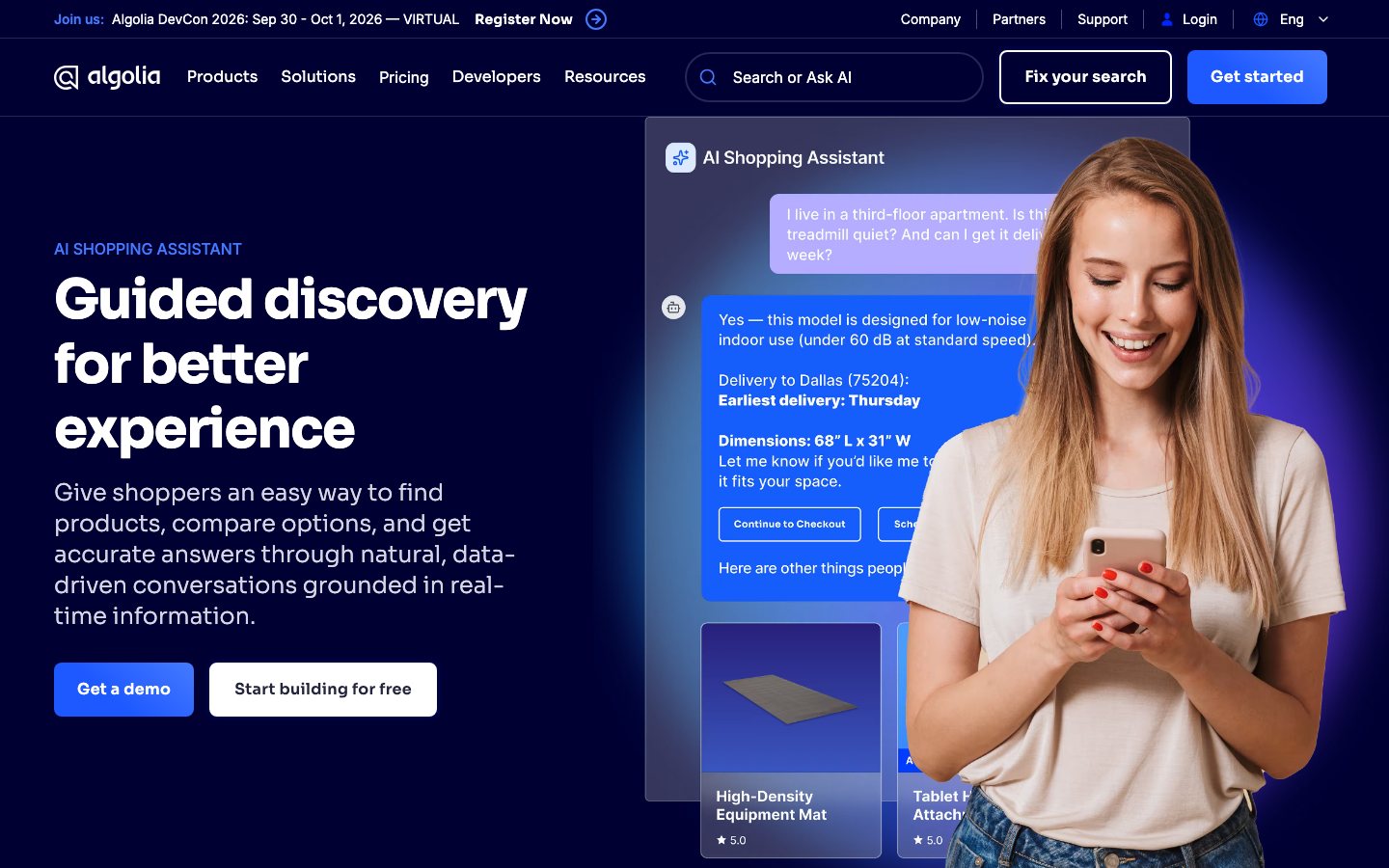
Before you start
- Choose one bounded, reversible conversion experiment or merchandising change to test.
- Prepare traffic and funnel data, the current page or theme, product rules, and a measurable hypothesis, removing sensitive fields the trial does not need.
- Record the current conversion rate, revenue per visitor, add-to-cart rate, and guardrail metrics, then name the approver and stop conditions.
Operator-ready setup plan
Start with one real task
Do not begin with a store-wide rollout. Pick one reversible task where Algolia AI Shopping Assistant can help you improve product discovery, merchandising, and onsite conversion.
Checkpoint: The input boundary, owner, and one primary measure from conversion rate, revenue per visitor, add-to-cart rate, and guardrail metrics are written down.
Prepare the input and guardrails
Collect only the traffic and funnel data, the current page or theme, product rules, and a measurable hypothesis needed for this test. Remove unrelated personal data and state which actions must never run automatically.
Checkpoint: Every input has a known source, sensitive fields are minimized, and the approver knows what the trial can read or change.
Configure a contained trial
Follow the official setup path, connect the fewest accounts possible, and grant only the permissions this test needs. Let Algolia AI Shopping Assistant recommend before it acts.
Checkpoint: You have a conversion experiment or merchandising change that a responsible operator can inspect, and it stayed inside the approved boundary.
Review it against a baseline
Do not judge the result by fluency. Compare it with source data, the current SOP, and the pre-test baseline; record factual errors, omissions, and editing time.
Checkpoint: conversion rate, revenue per visitor, add-to-cart rate, and guardrail metrics has a pre-test baseline, and errors and exceptions are logged separately.
Expand in small batches with a stop rule
Increase one batch at a time and decide in advance what will stop the rollout. Add it to the regular SOP only after it repeatedly clears the quality bar.
Checkpoint: Wider use does not push error, complaint, or rework costs above the previous baseline.
How to test it
- Test one normal case, one edge case, and one case with a deliberately missing critical field.
- Compare the result with the pre-test baseline for conversion rate, revenue per visitor, add-to-cart rate, and guardrail metrics; do not record time saved alone.
- Review errors, human edits, permissions used, and unresolved exceptions before expanding scope.
Limits to account for
- We checked the public source and resource identity on 2026-07-19. That review does not cover every workflow result, and vendor performance claims are not treated as EcomAgentTools tests.
- A change that lifts one funnel metric can still hurt margin, accessibility, speed, or customer trust.
- This page reflects the review completed on 2026-07-19, not a permanent guarantee. Recheck the current documentation, pricing, and contract terms before production use.
Frequently asked questions
How do I add Algolia AI Shopping Assistant to the current SOP?
Map the input source, owner, approval point, and exception path, then replace one existing step. Do not rewrite the whole operation just to accommodate a new tool.
Which metrics show whether it is worth keeping?
Track conversion rate, revenue per visitor, add-to-cart rate, and guardrail metrics. Pair quality and efficiency measures so output volume is not mistaken for a business result.
When is it not worth using?
It is usually a weak fit when volume is low, inputs stay incomplete, most cases need senior judgment, or review costs approach the cost of the old process.
Key features
Algolia is an AI-powered search and discovery platform used by 17,000+ companies including Stripe, LVMH, and Under Armour to deliver instant product search, recommendations, and merchandising. Its NeuralSearch combines keyword matching with semantic AI understanding, returning sub-20ms results across web, mobile, and AI agent interfaces. The platform also includes A/B testing, dynamic re-ranking, and a merchandising studio for non-technical teams to control product visibility.
- NeuralSearch combining keyword and semantic AI vector search
- Instant search-as-you-type with sub-20ms response times
- AI-powered product recommendations with Dynamic Re-Ranking
- Merchandising Studio with no-code product ranking controls
- Built-in A/B testing with statistical significance analysis
- Federated multi-source search across product catalogs and content
- Revenue Analytics connecting search interactions to purchase data
- Personalization engine building user affinity profiles
Best for
You see shoppers struggle to find, filter, or rank the right products. The first decision to test is whether NeuralSearch combining keyword and semantic AI vector search and Instant search-as-you-type with sub-20ms response times hold up together before removing one clear… Consider it when these outcomes matter: NeuralSearch combining keyword and semantic AI vector search, helping you help shoppers reach a relevant product set faster; Put Instant search-as-you-type with sub-20ms response times into the current flow to keep operational control over ranking and product rules; Use AI-powered product recommendations with Dynamic Re-Ranking in this step to validate on one page or query range before extending from behavior data. Confirm before rollout: Usage-based pricing scales rapidly — costs can spike unexpectedly with traffic growth.
Pricing analysis
Current published or described options are Free: $0 (10K requests/month); Build: $1 per 1,000 requests; Grow: From $129/month; Premium: Contact sales; Elevate: Contact sales. Free has the lowest acquisition cost for validating the workflow, while Build is the first useful cost baseline for steady use. A higher tier earns its premium through measurable labor savings, revenue lift, or lower unit cost—not through a longer feature list alone. Complete cost also includes monthly orders or traffic, feature packages, platform-tier requirements, implementation, experimentation, and incremental margin; model both normal and peak periods. A custom quote should state the billing unit, minimum commitment, overages, add-ons, implementation scope, renewal terms, and data-export path.
Pros
- Industry-leading sub-20ms search speed at global scale
- Free tier available with 10,000 requests per month
- Deep customization of ranking, filtering, and relevance controls
- Strong developer ecosystem with SDKs for all major frameworks
Limitations
- Usage-based pricing scales rapidly — costs can spike unexpectedly with traffic growth
- Advanced features like A/B testing and multi-cluster require Premium or Enterprise plans
- No self-hosting option, creating vendor lock-in risk
- Complex setup requires significant technical resources
Selection guidance
Document the current manual process, data sources, owner, and recovery path, then run one high-traffic journey or merchandising placement with a control group with real business data. Cover permission boundaries, null and exception data, duplicate execution, human override, third-party sync delays, export, and rollback. Also run these product checks: Test one normal case, one edge case, and one case with a deliberately missing critical field.; Compare the result with the pre-test baseline for conversion rate, revenue per visitor, add-to-cart rate, and guardrail metrics; do not record time saved alone.. Keep the pilot live for a complete business cycle and compare conversion rate, average order value, revenue per visitor, response latency, and merchandising effort with the pre-pilot baseline. Contract only if quality, controllable risk, and total cost all pass, and explicitly test these known constraints: Usage-based pricing scales rapidly — costs can spike unexpectedly with traffic growth; Advanced features like A/B testing and multi-cluster require Premium or Enterprise plans.
Published pricing
- Free
- $0 (10K requests/month)
- Build
- $1 per 1,000 requests
- Grow
- From $129/month
- Premium
- Contact sales
- Elevate
- Contact sales
Alternatives
Content checked: