ZooData
ZooData Data Products is a commerce-data API and web-extraction service for developers and research teams that need structured product and business data for analysis and automated workflows. Teams can query documented commerce endpoints or convert a public page into JSON, Markdown or HTML. Amazon and TikTok Shop are data coverage—not native store apps—and production use still needs development, validation and credit monitoring.
ZooData Data Products is a commerce-data API and web-extraction service for developers and research teams that need structured product and business data for analysis and automated workflows. Teams can query documented commerce endpoints or convert a public page into JSON, Markdown or HTML. Amazon and TikTok Shop are data coverage—not native store apps—and production use still needs development, validation and credit monitoring.
ZooData Data Products is a commerce-data API and web-extraction service for developers and research teams that need structured product and business data for analysis and automated workflows.
- Views
- 0
- Uses
- 0
- Favorites
- 0
- Editorial Score
- 75/100
- Supported Platforms
- Amazon · TikTok Shop · Web
- Freshness
- Reviewed Sep 2026
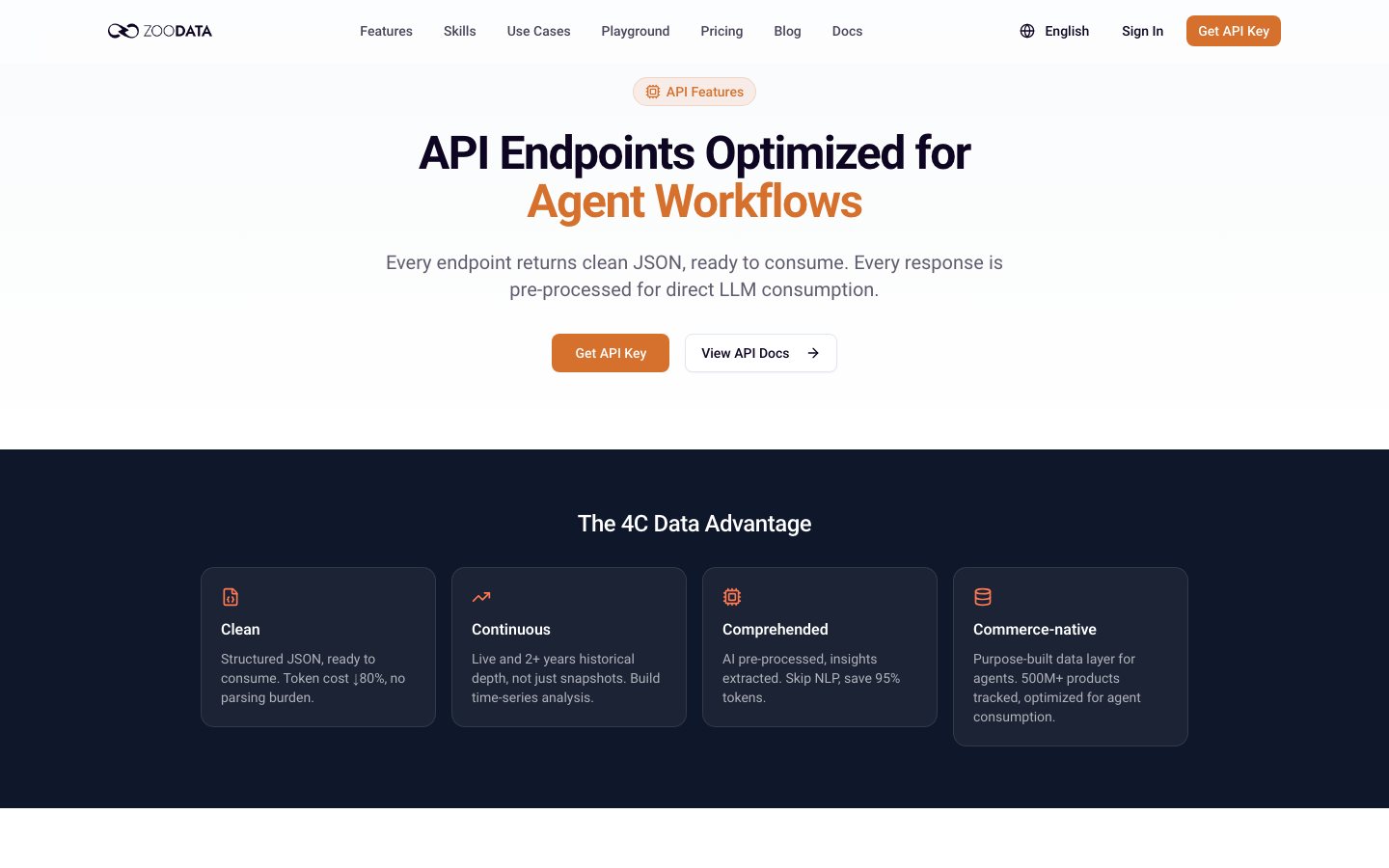
Buying view: ZooData is easier to shortlist than a quote-only data vendor because it publishes prepaid and package pricing. Its value still depends on whether the exact market, field and freshness you need are available and reliable in a pilot.
Capabilities
ZooData helps ecommerce teams investigate what to sell, how competitive a market is and what buyers care about. It offers Web research tools for Amazon and TikTok Shop, plus data APIs and prepared workflows for an AI assistant. Its central appeal is combining product, category, competitor, review and keyword signals with AI-ready data, so recurring research can move from repeated manual collection toward structured queries and AI-assisted analysis. Operators can research directly in the browser or use an AI assistant that the team has configured to access ZooData.
What problem it addresses
Product selection often involves separate checks of category demand, individual products, competitors, reviews and search terms. A promising sales figure alone does not show whether large brands dominate the niche, buyers repeatedly report a defect or demand is changing. ZooData brings these research signals into queryable tools so the team can compare candidates and decide what deserves closer investigation.
How people use it
Operators can use the Web Console to choose a research tool and enter categories, keywords or product IDs, then narrow the query with filters. Teams that want AI-assisted research need someone familiar with setup to connect a ZooData API key—an access credential—to a compatible AI tool and install the relevant Skills. After setup, an operator can ask ordinary-language research questions in that AI tool, while developers can also feed the data into internal reports or automation. The Web research screens and AI-host workflows are different ways to use the service; each function below identifies the relevant route.
Documented operating situation
ZooData’s OpenClaw guide uses the stroller market as an example: the operator asks whether it is worth entering, and the configured Market Entry Analyzer identifies the category, retrieves market metrics, filters products and returns an enter, caution or avoid assessment with reasons. The useful output is a research judgment grounded in retrieved data, which the team can examine before deciding what to investigate or source next.
Amazon research covers category opportunities, product selection, competitors, customer reviews and keywords. TikTok research adds product and creator/video data, while the image, web-extraction and AI workflow tools support other collection and analysis tasks.
Web research tools serve manual queries; functions described as APIs need a connected tool, and Skills run in the team’s AI assistant. The groups show different research jobs, rather than a single process that runs every function automatically.
What each module does and its role
Amazon market opportunities
Before entering a new category, an operator can use Market Research to compare demand, price levels and competition across niches. The Web page lets the operator choose a category, time period and product sample, then filter by sales signals, brand concentration and the share of new products. This helps narrow the categories worth investigating and spot markets dominated by a few brands. These statistics describe product samples, rather than a complete account of every sale in the market.
Amazon product screening
Product Research helps an operator turn a broad category into a shortlist of products to investigate. The Web page offers presets such as new products, rising sales and beginner recommendations, together with filters for price, monthly sales, review count, rating, listing age and fulfillment method. For example, a team can look for products within its target price range that show demand but have relatively few reviews. Sales estimates and ranking signals help screen candidates; they do not establish sourcing costs or the profit the team could earn.
Amazon competitors and history
Competitor Research helps an operator identify comparable products and understand how they compete. A search can start with a keyword, brand, seller or Amazon product ID (ASIN); ZooData also provides current product details and historical records for price, sales rank, ratings and other supported fields. Comparing today’s position with the historical record helps investigate whether a competitor has changed price, improved its sales rank or accumulated more reviews. Product, history and current-detail queries provide different fields and update intervals, so one snapshot should not be treated as a continuously updated view of every metric.
Amazon customer review insights
VoC Analysis helps a team understand what buyers praise, complain about and want improved before developing a product or rewriting its listing. The operator enters product IDs or a category and chooses a period; ZooData aggregates sentiment, ratings, pain points, purchase reasons and usage scenarios. These findings can guide product-improvement questions and identify benefits or concerns that the listing should explain. The aggregate analysis is separate from individual review text, which is available through a different review-search function.
Amazon keyword research
Keyword Research helps an operator investigate what shoppers search for and how products appear around those queries. Starting with a keyword or ASIN, the documented functions support related-term discovery, demand and trend analysis, competitor keyword lookup and product traffic-term analysis. The results can help build a keyword research list and investigate changes in search visibility. ZooData’s search and exposure signals are estimates; conclusions about actual conversion, advertising profitability or bid amounts also require the seller’s performance and cost data.
TikTok Shop product research
TikTok Shop research helps an operator find products gaining sales and compare the shops and items competing in the same niche. Its Web pages support product discovery and competitor lookup using categories, keywords, product IDs and shop information, with filters such as price, recent sales, growth, ratings and shipping. The documented data service also supplies current product details, inventory and variants for selected products. The current product-data documentation specifies the US market; Amazon’s research functions should not be assumed to have identical TikTok coverage.
TikTok creator and video research
For a team planning creator collaborations or researching content, ZooData provides APIs to find TikTok creators and videos by category, audience and commerce-related signals. Documented filters include creator attributes, video views, engagement, publication time and whether a video features a shoppable product. These results can supply a shortlist for the team’s own creator or content analysis; using this capability requires a connected tool or implementation, and the creator snapshot is currently scoped to the US. Sales of products a creator promoted are not automatically sales attributable to that creator.
Fashion and product matching
Fashion teams can use ZooData’s image and search APIs to investigate similar styles from a picture or a text description. The documented functions detect clothing and accessories within an image and search for similar fashion products, returning information such as title, brand, price, image and retailer link. A separate ecommerce relevance function can reorder a supplied set of product descriptions against a search query. These are functions for a connected research or search tool; placing them in a store requires integration rather than simply activating a storefront widget.
Web research extraction
Web extraction helps an operator or connected AI tool collect usable research material from a public product page or article. The homepage provides a URL input, while the WebTools service can return clean text or structured summaries containing the title, key facts and main entities. Its API also documents web search, site-link discovery and multi-page crawling for broader collection tasks. The result is source material for comparison or analysis; pages that refuse access may return an error instead of usable content.
AI reports and monitoring
ZooData publishes Skills: prepared research workflows that run inside a compatible AI assistant after the team connects its ZooData API key. They guide the assistant through jobs such as market-entry assessment, opportunity discovery and competitor analysis; the pricing and listing-audit Skills describe price recommendations, issue lists and suggested copy. Daily Market Radar uses a saved baseline to compare later observations and report changes, with recurring runs requiring scheduling in the host environment. Reports, price suggestions and copy drafts still need the team’s judgment and execution; they do not by themselves change store prices or publish listings.
Commercial plans
Choose by how the data will be used: API credits pay for calls from software or agents, while Web Plans provide browser research and export access. ZooData’s API quick start begins with a free account and API key, without a Web Pro prerequisite. Budget for both paid offers only when the team needs paid API usage as well as Web Pro benefits.
Simple Credit-Based Pricing
For teams calling ZooData from software or AI agents to retrieve product, market and competitor data. API calls consume credits at rates that vary by endpoint; credits are bought as needed, with no subscription or seat fee. Top up suits occasional use because its credits never expire; the four fixed packages offer lower unit prices but expire after six months.
| Product or sales surface | Scope | Public price and status |
|---|---|---|
| Top up | Custom credit purchase for occasional API use; credits never expire. Included plan entitlements
| From $10 for 5,000 credits; $2 per 1,000 credits |
| Basic | 50,000 credits, six months, 120 RPM, 10 concurrent Included plan entitlements
| $69 one-time |
| Standard | 300,000 credits, six months, 180 RPM, 20 concurrent Included plan entitlements
| $299 one-time |
| Advanced | 1.5M credits, six months, 300 RPM, 50 concurrent Included plan entitlements
| $999 one-time |
| Ultimate | 10M credits, six months, 600 RPM, 100 concurrent Included plan entitlements
| $4,499 one-time |
Web Plans
For people doing research and exporting data in the browser. Free provides basic research and limited exports; Pro adds unlimited research and exports plus priority support. These are Web access benefits: the published Pro plan does not list an API credit allowance, so its unlimited research should not be treated as unlimited API calls.
| Product or sales surface | Scope | Public price and status |
|---|---|---|
| Free | Basic browser research with limited data exports. Included plan entitlements
| $0 |
| Pro | For regular browser research requiring unlimited exports and priority support. Included plan entitlements
| $29 monthly$276/year ($23/month equivalent) |
Generative AI is ZooData’s separate service for calling AI models through an OpenAI-compatible API. It charges a USD balance by token usage, with prices depending on the model and volume; contact sales for a quote and balance activation. The USD balance and Data Products credits are not interchangeable; enterprise wallet consolidation requires a sales arrangement. Neither table above represents this model service.
Comparable tools: price and workflow
| Tool | Workflow difference | Official public price reference |
|---|---|---|
| Jungle Scout | Choose for an Amazon seller research suite and operator dashboard rather than a general developer data layer. | See current Jungle Scout plans |
| Helium 10 | Choose for a broader Amazon seller operating suite with keyword, listing and market tools. | See current Helium 10 plans |
| SellerSprite | Choose for seller-facing Amazon product and keyword research with a ready-made interface. | See current SellerSprite plans |
| Data Dive | Choose for a focused Amazon product and listing research workflow rather than reusable multi-market API output. | See current Data Dive plans |
| SmartScout | Choose for Amazon market maps and seller-facing analysis instead of building your own data application. | See current SmartScout plans |
Frequently asked questions
Is ZooData an Amazon or TikTok Shop app?
No matching marketplace listing was found in this refresh. The official product describes Amazon and TikTok Shop as data coverage; API and Web access remain separate from a native store installation.
Does Web Pro include API credits?
The published Web Pro benefits are unlimited browser research, unlimited data exports and priority support; no API credit allowance is listed. API access starts with an API key and 1,000 free registration credits. Beyond the available credits, API usage requires a separate top-up or credit package; buying Web Pro should not be assumed to cover it.
What should a pilot validate?
Test one endpoint and market against a known sample, then measure required-field coverage, freshness, outliers, credit use, retries and concurrency before scaling.
Sources
- Official features
- Official API documentation
- Official pricing
- Official pricing configuration
- Separate Generative AI pricing
- Product Hunt product page
- ZooData Web research tools
- Amazon product filters
- Amazon market research
- Amazon review insights
- TikTok Shop product research
- Current public API specification
- Official ZooData Skills
- ZooData Skills in OpenClaw
- Fashion image research APIs
User reviews
ZooData
Content checked: